Why Are Alto Adige White Wines So Good?
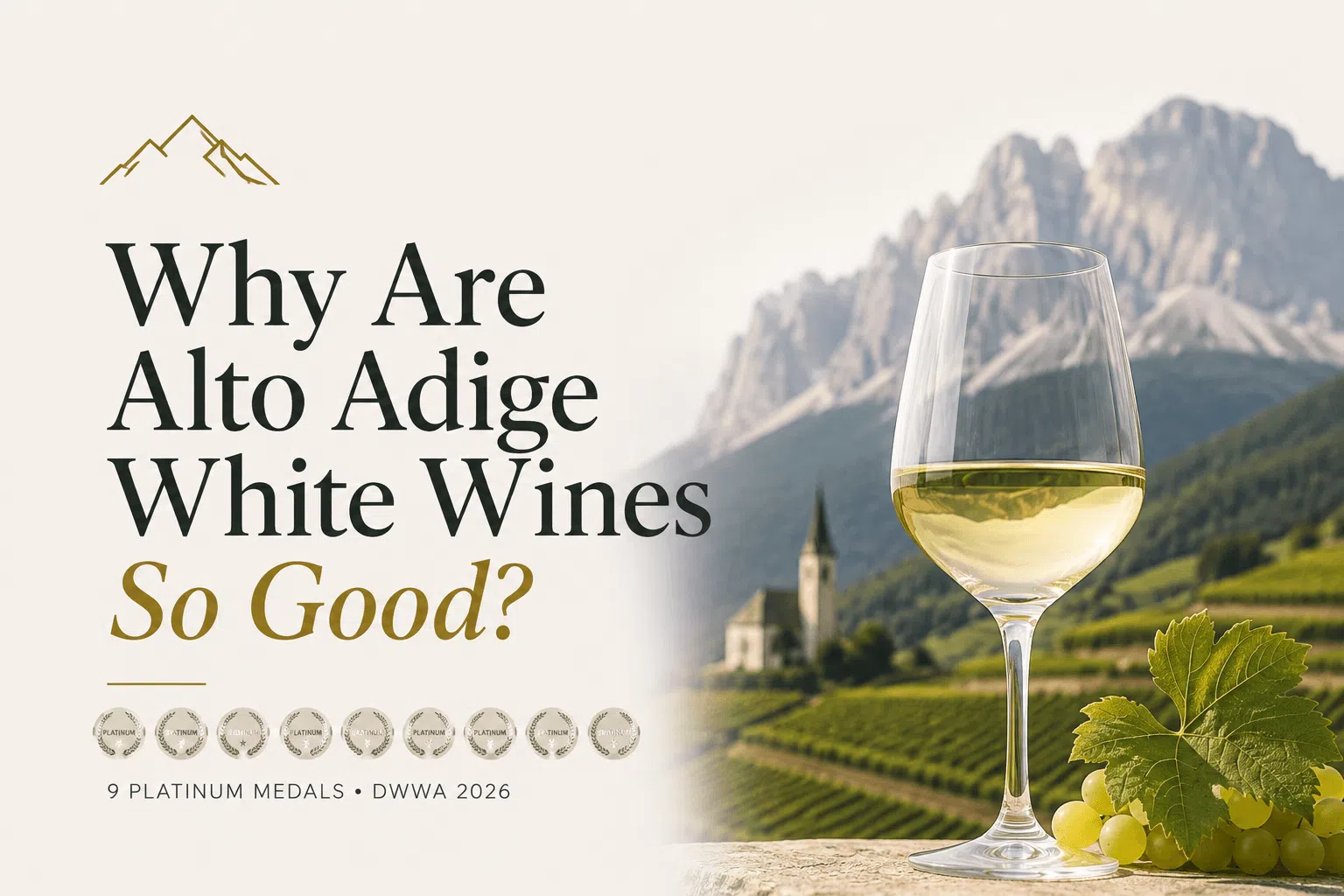
Nine Platinum medals. Every single one for white wine. From one of Italy’s smallest wine regions.
At some point, that stops being a lucky year. It starts being a pattern.
The medals came from the 2026 Decanter World Wine Awards, where Alto Adige outperformed every other Italian region or sub-region at Platinum level. Results were announced in June. In August, Decanter went back and asked the obvious follow-up question: what is this region doing right?
Fair question. Here’s mine: why did it take this long for anyone to ask?
Because Italian wine conversations have a script, and the script is red. Barolo. Brunello. Amarone. Chianti. Say “great Italian wine” at a dinner table and watch how fast someone reaches for a tannic red they can namedrop with confidence. Meanwhile, tucked against the Austrian border, Alto Adige has been quietly making some of the country’s most interesting white wine. Almost nobody outside the trade bothered to notice until nine medals forced the issue.
Where Alto Adige Sits, and Why That Matters
Alto Adige, also called Südtirol or South Tyrol, is Italy’s northernmost wine region. Keep driving until the road signs start speaking German too, and you’ve found it.
This is Dolomites country, and some vineyards climb toward 1,000 meters above sea level, high enough that farming there once looked more stubborn than strategic. The region gets plenty of daytime sun and warmth, which ripens the grapes properly. Then temperatures drop hard at night, which protects the acidity and aroma that keep a white wine tasting alive instead of flat.
Warm days, cold nights. The grapes get to ripen and then get sent straight to bed, which is more discipline than most of us manage on holiday. Growing seasons elsewhere keep getting hotter. A vineyard that looked inconveniently high up a mountain twenty years ago is starting to look suspiciously like it planned ahead.
Then there’s the ground itself. Alto Adige’s soils range from limestone to gravel to volcanic porphyry. At Cantina Terlano specifically, quartz-rich porphyry plays a real role in wines known for both freshness and, less expectedly, serious aging potential. Wine people get suspiciously excited about rocks at the best of times. Here, for once, the excitement is earned.
What Alto Adige White Wine Tastes Like
There’s no single Alto Adige flavor, since the region grows several different white grapes well. But there’s a family resemblance: fresh, aromatic, lively, usually with real acid backbone. Depending on the grape, you’ll find citrus, apple, pear, white flowers, herbs, stone fruit, or spice.
If your mental model of Italian white wine is something pale and forgettable served ice-cold next to seafood, Alto Adige is here to ruin that assumption. Some bottles genuinely are that easy and refreshing, nothing wrong with that. Others do something white wine isn’t supposed to do at all.
They age. Properly.
Cantina Terlano’s Rarity 2013, a Pinot Bianco, sat aging for over a decade before anyone was even allowed to buy it. It showed up at a 2026 awards competition and judges called it remarkably youthful. A thirteen-year-old white wine, walking into a room full of much younger competition, and still looking like it had the most to say. Red wine has spent centuries getting all the credit for patience. Apparently nobody told Pinot Bianco it wasn’t invited to that conversation.
The Grapes Worth Learning
You don’t need to memorize the whole region. A handful of names cover most of what’s worth knowing.
Pinot Bianco is where I’d start. Sometimes labeled Weissburgunder, it does particularly well in Alto Adige’s higher vineyards, giving apple, pear, and citrus with lively acid and a clean, precise style. The better examples age into something considerably more complex than the grape’s quiet reputation suggests.
Sauvignon Blanc here tends to be intensely aromatic without losing the freshness that makes the grape worth drinking in the first place. Citrus, herbs, and fruit, held together by the region’s cooler nights.
Gewürztraminer has a genuinely local claim: the village of Tramin, Termeno in Italian, is tied directly to the grape’s name. The wine itself is impossible to mistake once you’ve had it, floral, spicy, and unapologetically loud.
Kerner is the one worth remembering if you like discovering grapes before your friends have heard of them. Here’s the twist: it’s a crossing of Riesling and Schiava, and Schiava is a red grape. A crisp, aromatic white wine with a red grape as one of its own parents. Wine family trees are apparently messier than most family trees. In Alto Adige, Kerner thrives in high vineyards and produces aromatic, spicy, lively wines, and Cantina Valle Isarco’s Aristos Kerner 2024 earned the sub-region’s first-ever Platinum medal at the Decanter World Wine Awards this year. A genuinely rare grape, getting genuinely rare recognition.
Pinot Grigio and Chardonnay also grow here, and neither behaves like the version you’re used to. Cooler sites give Alto Adige Pinot Grigio more character than its usual anonymous reputation, and the region’s Chardonnay ranges from easy and approachable to serious enough to age.
Alto Adige and Südtirol Are the Same Place
Worth clearing up before it causes confusion at a wine shop: Alto Adige is the Italian name, Südtirol is the German name, South Tyrol is the English version. Same region, three names, because it’s genuinely bilingual. Seeing both Italian and German on a label is normal. Your bottle hasn’t quietly crossed a border.
This same bilingual, borderland identity shows up across Italian wine law more broadly. A name on a label often carries as much legal weight as the wine inside it. I’ve gone deeper into how that classification system works if you want the fuller picture.
So What Explains the Nine Platinums
At the 2026 Decanter World Wine Awards, Alto Adige took nine Platinum medals, every one for white wine. The spread covered Pinot Bianco, Sauvignon Blanc, Chardonnay, Kerner, and white blends. That spread matters. This wasn’t one spectacular bottle carrying an entire region’s reputation. It was several grapes, several producers, all landing at the same level.
Cantina Terlano was among the standout names. Cantina Valle Isarco made its own history with Kerner. Cantina Tramin and Girlan were recognized too. The medals themselves aren’t really the story. They’re confirmation of something the region has been quietly building for years.
Where to Start
Don’t chase the most expensive Platinum winner you can find. Start with what you’d genuinely enjoy drinking. Crisp and elegant points toward Pinot Bianco. Aromatic and fresh means Sauvignon Blanc. Floral and spicy is Gewürztraminer. Curious and a little contrarian means Kerner.
If I had to pick one bottle to open first, it’s Pinot Bianco, not because it has the loudest reputation, but almost because it doesn’t. Alto Adige gives it room to show it’s considerably more interesting than the shelf you walk past on your way to Pinot Grigio.
Quick Answers
What is Alto Adige wine known for? Fresh, aromatic white wines, especially Pinot Bianco, Sauvignon Blanc, Gewürztraminer, and Kerner. High-altitude vineyards and cold nights are what preserve the acidity and aroma that define the style.
Is Alto Adige the same as Südtirol? Yes. Alto Adige is the Italian name, Südtirol the German name, both referring to the same bilingual region also known in English as South Tyrol.
What’s the best Alto Adige white wine to try first? Pinot Bianco for something crisp and precise, Gewürztraminer for floral and spicy, Sauvignon Blanc for aromatic freshness, or Kerner if you want something genuinely uncommon.
Why is Alto Adige so good for white wine specifically? Altitude is the biggest factor. Warm, sunny days ripen the grapes, while sharp overnight temperature drops preserve the acidity and aromatics that make a white wine taste bright rather than flat.
Salute.
Continue Exploring
- Decoding the Italian Wine Label: What DOCG, DOC, and IGT Actually Mean
- Red Wine vs White Wine: The Real Differences
- 5 Seafood-Friendly Italian White Wines You Need to Try
- 10 White Sangria Recipes to Enjoy
Enjoy wine without the snobbery?
Make The Finest Italian Wine one of your Preferred Sources on Google.
Add The Finest Italian Wine to Preferred SourcesDiscover more from The Finest Italian Wine
Subscribe to get the latest posts sent to your email.