The Real History Behind Lake Garda’s Most Haunted Castle
Quick Guide — Scaligero Castle, Sirmione
- Where: Sirmione, on a narrow peninsula at the southern tip of Lake Garda, Lombardy
- Built: Mid-to-late 13th century, under Mastino I della Scala, likely over earlier Roman fortifications
- The legend: A young noblewoman named Arice, murdered by a knight seeking shelter from a storm, and her husband Ebengardo, said to still wander the halls
- The real history: Sirmione sheltered the Patarines, a medieval sect the Church condemned as heretical — accounts differ on whether they were executed within the castle itself or in nearby Verona
- Today: One of Italy’s most visited historical sites, open to the public, reachable only on foot across a drawbridge
I promised you the full version of this story back when I first wrote about a family vineyard near Lake Garda. I’ve been meaning to sit down and give it the space it deserves ever since. So here it is, properly. All the detail the shorter version couldn’t hold.
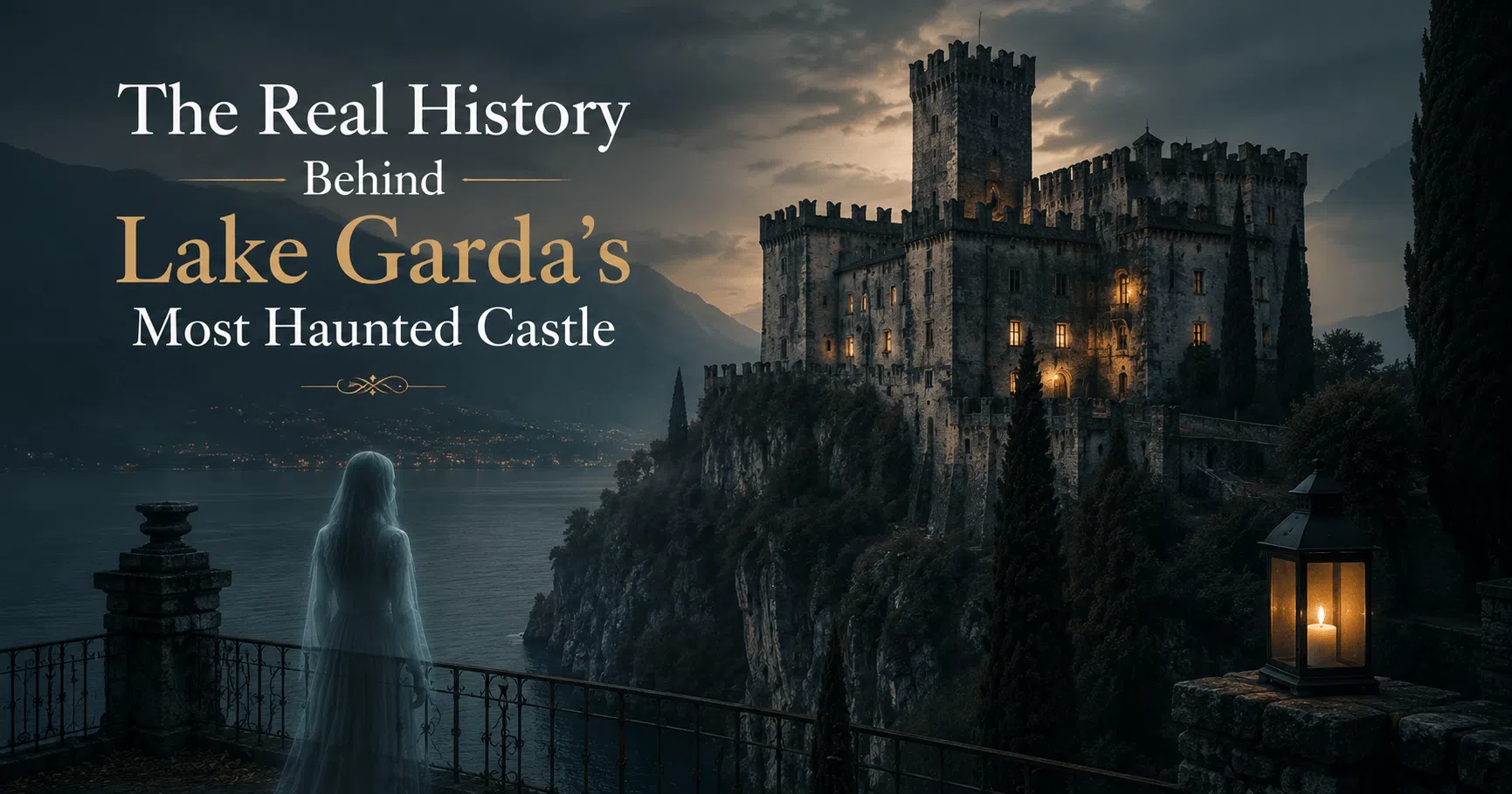
There’s a castle at the southern tip of Lake Garda that you reach the same way people have reached it for seven hundred years. On foot, across a drawbridge, with water on every side and cars left waiting outside the gate. It looks, from a distance, exactly like the castle a child would draw if you asked them to imagine one. Swallow-tailed battlements. A stone tower rising over the water. The whole silhouette almost too perfect to be real.
Then you hear the story attached to it, and the fairy tale version doesn’t survive very long.
Quick note before we go further, especially if you’ve already read the shorter version of this story in our Lake Garda wine vacation guide. This piece exists specifically to give you the parts that post didn’t have room for. If you already know the bones of the legend, skip ahead to the Patarines section below. That’s where the genuinely new material starts, and it’s the part I actually think is worth your time.
Who Was Ebengardo and Arice, and What Happened to Them?
The legend goes like this, and people have told it with small variations for centuries. That’s exactly what happens to a good story once enough people pass it along.
A young noble couple, Ebengardo and his wife Arice, lived inside the castle walls. Different retellings describe them differently. Some simply as newlyweds, others as a couple who’d already built a quiet, contented life together. But every version agrees on the same thing: they were happy, and it didn’t last.
One winter night, a violent storm rolled in off the lake, and a knight arrived at the gate asking for shelter. His name shifts slightly depending on which version you hear. Elaberto, Elalberto, sometimes given the title Marquis of Feltrino, sometimes described simply as a Venetian knight passing through. Whatever his exact origin, the couple did what hospitality demanded. They let him in.
He saw Arice, and something in him decided the rules that had just let him through the door no longer applied. Under cover of night, he went to her room. She fought him, screamed, refused to give in, and he killed her rather than accept no for an answer.
Ebengardo arrived only in time to find his wife already gone. Blind with grief and rage, he turned on the knight with whatever weapon was closest and ended his life on the spot.
That’s where the legend proper ends, and where the haunting begins. Locals say that on stormy nights, Ebengardo’s spirit still moves through the castle, still searching for a wife he’s never going to find. Whether you believe in ghosts or not, there’s something genuinely unsettling about a love story that ends exactly there and simply never resolves.
Is the Sirmione Castle Ghost Story Actually True?
Almost certainly not in any literal sense. But that’s slightly beside the point.
No historical record connects an Ebengardo, an Arice, or a murdered bride to any documented event at the castle. It’s folklore, the kind every old European fortress seems to collect eventually. A beautiful, isolated, slightly melancholy building practically begs for a tragic story to explain why it feels the way it does.
What’s genuinely interesting is that the castle didn’t need an invented tragedy to have a dark chapter. It already had one, and this part isn’t folklore at all.
What Really Happened to the Patarines at Sirmione?
This is the part of the story that tends to get skipped over on the standard tourist walk-through, and it deserves better than a footnote.
At various points in its medieval history, Sirmione became a refuge for the Patarines. A religious movement the Catholic Church considered heretical, broadly associated with beliefs shared by the wider Cathar movement, including the idea that the material world was the devil’s creation while only the soul belonged to God. That kind of theology did not sit well with Rome. The consequences for anyone holding it were severe.
Here’s where I want to be honest rather than smooth things over for a cleaner story. Historical sources describe the ending differently. Some accounts state plainly that the Patarines sheltering at Sirmione met their end on the Pope’s orders, inside the castle itself, burned in the courtyard on blazing pyres in full view of the fortress walls. Other sources place the actual executions not at Sirmione but in Verona, in 1278, at the hands of the ruling della Scala family who controlled both cities.
I can’t tell you with certainty which version holds the precise, documented truth. I’d rather admit that honestly than pretend there’s a single tidy answer. What both versions agree on, without exception, is this: real people who took refuge in or around this castle lost their lives to fire, for what they believed, under official religious and political authority. That part isn’t legend. That happened.
Which makes for an extraordinary, slightly uncomfortable contrast. A castle famous for one entirely invented ghost story, sitting on top of an actual, documented history of people burned alive for their faith. And it’s the fictional grief that gets top billing on the tour.
Who Actually Built Scaligero Castle, and Why?
The castle itself is real and thoroughly documented. It’s also considerably older in its origins than either story attached to it. Honestly, the actual construction history is almost as dramatic as the folklore, just in a quieter, more bureaucratic way.
Mastino I della Scala commissioned construction in the latter half of the 13th century. Some records call him Leonardino della Scala instead, because apparently even medieval Italian nobility couldn’t commit to a single name. Builders likely raised it directly over the remains of an earlier Roman fortification. The della Scala family, known as the Scaligeri, ruled Verona and a substantial stretch of the surrounding Venetian territory from 1259 to 1387. They didn’t build this castle out of sentiment. It was a port fortification first, defending Sirmione against outside enemies as much as keeping a watchful eye on the locals themselves. Nothing about it was decorative. Everything about it was strategic.
Long Before the Scaligeri Arrived
What I find genuinely charming, in a slightly morbid way, is that Sirmione had already been worth fighting over for well over a thousand years by the time the Scaligeri got involved. As far back as the 1st century BC, wealthy families from Verona were already treating this exact peninsula as their retreat of choice. They came for the natural thermal springs, and presumably for the same views that still stop people in their tracks today. The Grotte di Catullo, the ruins of a Roman villa nearby linked to the poet Catullus, prove that people were choosing this specific stretch of shoreline for its beauty long before anyone thought to put a castle on it. Some things about good real estate never change.
Venice took formal control in 1405, once the della Scala family submitted to Venetian rule. The castle stayed militarily relevant until the 16th century, when a newer fortress at Peschiera del Garda quietly took over its job. After that, it settled into a long, unglamorous career as a garrison, right through to Italian unification in 1861. Restoration work in 1919 finally turned it into the museum it is today. Which is, I suppose, the natural retirement plan for any building that’s spent seven centuries being fought over. Eventually, someone lets it just be beautiful instead.
Can You Actually Visit Scaligero Castle Today?
Yes, and it remains one of the most visited historical sites in the entire country. It ranked 22nd among Italy’s most visited attractions in 2019, drawing over 300,000 visitors that year alone, inside a town that pulled in more than 1.2 million tourists overall.
You reach it the same way visitors always have. On foot, across the drawbridge, since Sirmione’s historic centre doesn’t allow cars past its gates. Once inside, you can climb the tower for a genuinely spectacular view across Lake Garda. Walk the same courtyard where legend says a fictional tragedy unfolded and documented history says a real one did. Finish at the small harbour that once sheltered the Scaligeri’s own fleet.
If you want the practical details on planning an actual trip here, where to stay, what else to see on this stretch of Lake Garda, how it fits into a wider wine vacation, our Lake Garda wine vacation guide already covers that ground properly. This piece is the story behind the story. That one is how you actually go.
Frequently Asked Questions — Scaligero Castle, Sirmione
Is the Sirmione castle ghost story real? No historical evidence supports it. No documented Ebengardo, Arice, or murder connects to any recorded event at the castle. It’s a folklore legend, the kind many European castles eventually accumulate.
Were people actually executed at Sirmione castle? Sirmione sheltered the Patarines, a medieval sect the Catholic Church condemned as heretical. Historical accounts differ on whether their execution by burning took place within the castle itself or in nearby Verona in 1278, but the persecution and executions themselves are historically documented.
Who built Scaligero Castle? Mastino I della Scala, of the della Scala (Scaligeri) family who ruled Verona, commissioned construction in the latter half of the 13th century, likely over the remains of an earlier Roman fortification.
Can the public visit Scaligero Castle? Yes. It’s open to visitors, accessible only on foot across a drawbridge, and ranks among Italy’s most visited historical sites, with a small entry fee.
Why is Sirmione significant beyond the castle? Sirmione has drawn visitors since Roman times. It’s home to natural thermal springs and the Grotte di Catullo, the ruins of a Roman villa linked to the poet Catullus.
One Last Thing
What actually unsettles me about this castle isn’t the invented ghost at all. It’s the fact that the invented story is the one everyone remembers, while the real one, people burned alive for believing something different from what they were told to believe, gets a single line on a plaque, if it gets mentioned at all.
Ebengardo never existed, as far as anyone can prove. The Patarines did. Somewhere in that gap between the story we like to tell and the one that actually happened, there’s something worth sitting with for a minute before you cross back over that drawbridge and go looking for something to eat.
For the practical side of visiting, where to stay, what else this stretch of Lake Garda offers, how it fits into a wider Veneto wine trip, read our full Lake Garda wine vacation guide, or explore the rest of the Veneto wine vacation series.
— Kelly 🍷
#Sirmione #LakeGarda #ItalianHistory #ScaligeroCastle #WineAndTravel #ItalyTravel
Enjoy wine without the snobbery?
Make The Finest Italian Wine one of your Preferred Sources on Google.
Add The Finest Italian Wine to Preferred SourcesDiscover more from The Finest Italian Wine
Subscribe to get the latest posts sent to your email.