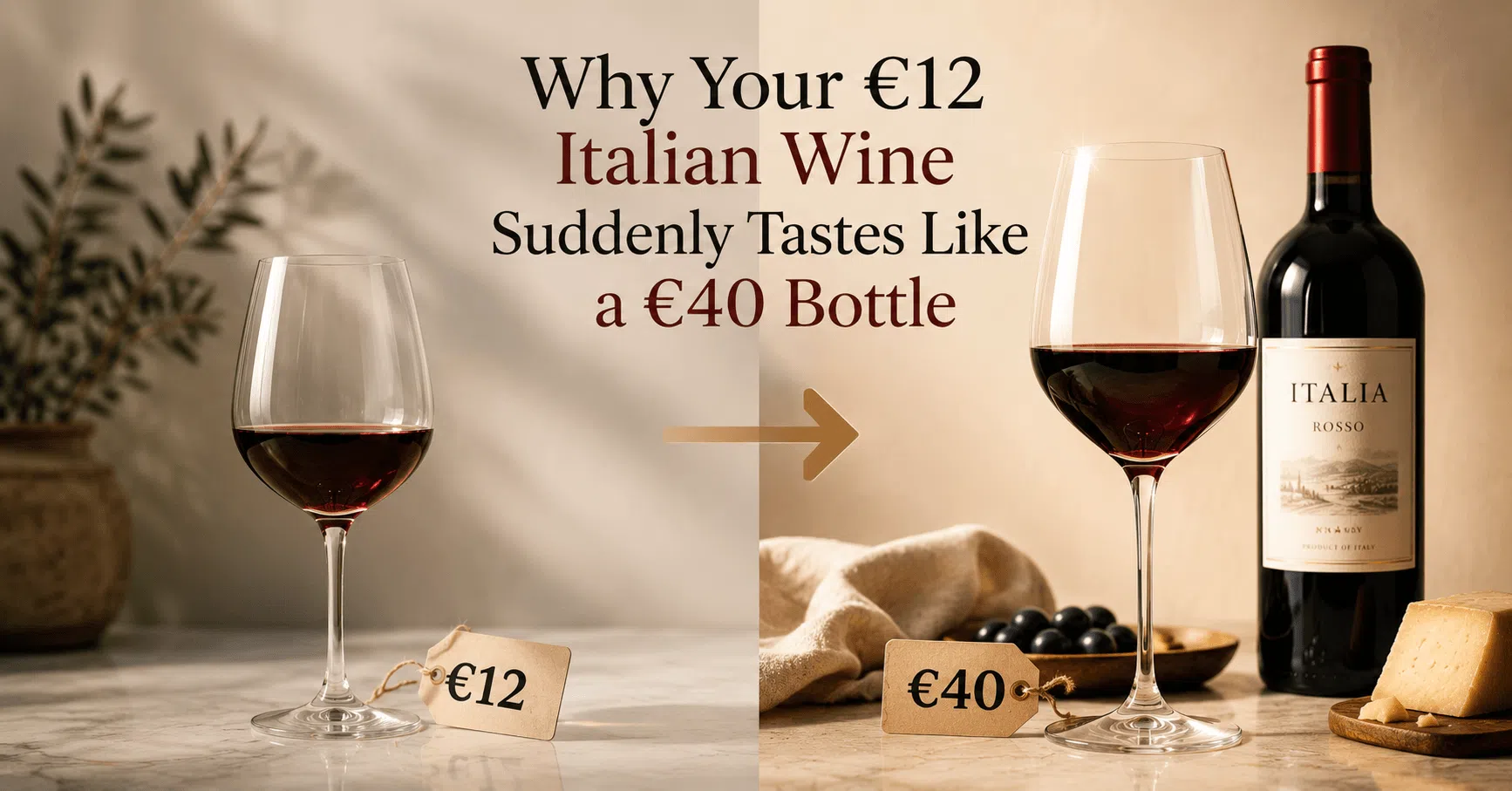
Why Your €12 Italian Wine Suddenly Tastes Like a €40 Bottle
Quick Guide — The Italian Wine Downgrade
- What’s happening: Italian wine cellars are sitting on over 53 million hectolitres of unsold stock, the highest level since 2022
- The result: Roughly one in five bottles is currently being declassified — moved down from DOCG to DOC, or DOC to IGT, to clear tank space before the next harvest
- The cost to the industry: An estimated €516 million in losses for 2026
- What it means for you: Some genuinely well-made wine is landing on shelves wearing a far humbler label than the juice inside deserves
I noticed it before I understood why. A bottle that had no business tasting as good as it did, sitting on the everyday shelf at my local shop here in Veneto, priced like it wasn’t expecting anyone to take it seriously.
Turns out I wasn’t imagining things, and neither are you if you’ve had the same experience lately. There’s a genuinely significant shake-up happening across Italian wine right now, and for once, the story behind a cheap bottle tasting suspiciously good isn’t a fluke. It’s an entire industry quietly moving very good wine into very ordinary bottles, because it doesn’t have much choice.
Why Are Italian Wineries Downgrading Their Own Wine?
Because their cellars are full, and the next harvest isn’t waiting around for anyone to sell through the last one.
As of May 2026, Italian cellar stocks — wine and unfermented must combined — passed 53 million hectolitres, up more than 7% on the previous year and the highest level since 2022. That’s roughly an entire year’s harvest sitting unsold in tanks, with another harvest already on its way.
At the same time, demand has gone soft on two fronts at once. Domestic supermarket wine sales dropped around 2% in the first five months of 2026 compared to the year before, and exports fell even harder — down roughly 8.3% in value in the first quarter alone, with the expected rebound in American demand simply never showing up. Three consecutive lighter harvests should have helped balance things out. It hasn’t been enough.
So producers are doing the only thing that actually clears space quickly: declassifying. Lamberto Frescobaldi, president of Unione Italiana Vini, has said plainly that roughly one in five bottles produced right now is being moved down a tier — DOCG dropped to DOC, DOC dropped to IGT, and in around three-quarters of cases, all the way down to basic table wine. The industry is looking at an estimated €516 million in losses from this in 2026 alone.
None of that is speculation or gossip picked up secondhand. It’s coming directly from the organisation that represents Italian winemakers.
How Does Italy’s Wine Classification System Actually Work?
You need the pyramid to understand what “declassifying” even means, so here it is in the simplest version I can manage.
DOCG (Denominazione di Origine Controllata e Garantita) sits at the top — the strictest tier, requiring a government tasting panel and chemical analysis before a wine is allowed to carry the label at all. Barolo, Chianti Classico, Brunello di Montalcino — all DOCG.
DOC (Denominazione di Origine Controllata) is the broader, still-regulated tier below it — the working backbone of Italian wine that most people encounter in a normal wine aisle.
IGT (Indicazione Geografica Tipica) sits below both, introduced in 1992 partly to give winemakers room to work outside the stricter rules — famously the tier that early vintages of Sassicaia and other Super Tuscans were released under, since their grape blends didn’t fit the traditional rulebook of the time.
Vino da Tavola, or basic table wine, sits at the very bottom, with essentially no rules beyond “it must be wine, made in Italy.”
Ordinarily, a producer fights hard to earn and keep the highest classification they can, because it’s what lets them charge accordingly. Declassifying voluntarily is normally a rare, deliberate stylistic choice — a handful of ambitious winemakers doing it on purpose to escape a rulebook they’ve outgrown. What’s happening right now is different. This is an entire industry doing it at scale, out of necessity rather than ambition, simply to move wine off shelves and out of tanks before harvest arrives.
Can You Actually Spot a Declassified Wine on the Shelf?
Sometimes, though I’d be lying if I told you it’s a guaranteed trick rather than an educated guess.
The clearest signal is the fine print on the back label, specifically the words “Imbottigliato da” — bottled by. If that address traces back to a genuinely prestigious estate or a well-known sub-zone, that’s a reasonable hint the juice inside started life aiming for a higher shelf than the one it landed on. It’s not a certainty. Plenty of large, perfectly respectable IGT producers bottle honestly under their own name with no hidden story at all. But it’s worth a glance.
Beyond that, honestly, the most reliable approach is the boring one: buy from producers whose DOC or DOCG wines you already trust, and try their IGT or entry-level bottling in a year like this one. If a winemaker knows what they’re doing at the top of their range, that skill doesn’t evaporate just because the label says something humbler this vintage.
Should You Actually Take Advantage of This?
I don’t see why not, provided you’re realistic about what you’re buying and why.
This isn’t really a loophole you’re exploiting or a system you’re cleverly outsmarting, however satisfying that framing sounds. It’s simply a rough year for Italian wine producers, and one honest side effect of that roughness is that some genuinely well-made wine is temporarily available at prices that don’t reflect the skill or land it came from. Buying it doesn’t cost you anything extra in quality. It just means paying attention rather than assuming a humble label always means a humble wine.
If anything, this is a good year to be a slightly more adventurous shopper than usual. The €12 bottle doing an unusually convincing impression of something twice the price isn’t a coincidence this year. It’s an industry working through a genuine oversupply problem, and for once, that problem is landing gently in your favour.
Frequently Asked Questions — Italian Wine Declassification
Why is Italian wine being declassified right now? Because Italian cellars are holding record levels of unsold stock — over 53 million hectolitres as of May 2026 — driven by weak domestic and export demand. Declassifying wine into a lower category is one of the fastest ways producers can clear tank space before the next harvest arrives.
What does declassifying a wine actually mean? It means a wine that would normally qualify for a higher classification, such as DOCG or DOC, is instead released under a lower one — DOC, IGT, or basic table wine — usually to meet yield limits, move inventory faster, or in the current climate, simply because there’s too much wine and not enough demand.
Does declassified wine taste worse than the original classification would suggest? Not necessarily. Declassification is a legal and labelling decision, not a quality judgment on the wine itself. The same grapes, vineyard, and winemaking team can sit behind a bottle regardless of which tier it’s ultimately released under.
How much is this costing the Italian wine industry? Industry estimates put the losses from this wave of declassification at around €516 million for 2026, driven by falling export values and softening domestic sales.
One Last Thing
I don’t think there’s anything particularly scandalous happening here, whatever the more dramatic corners of the internet want to call it. It’s just an industry having a genuinely difficult year, doing the practical thing to survive it, and one accidental side effect of that is a run of unusually good everyday bottles sitting quietly on ordinary shelves.
Buy accordingly. Ask a few more questions than usual at the wine shop. And if a bottle without much fanfare on the label ends up tasting far better than its price suggested it should, don’t overthink it too hard.
If you want specific bottles rather than a general strategy, our Best Cheap Italian Wines That Taste Expensive rounds up exactly which everyday names consistently overdeliver, glut or no glut.
Just enjoy the glass.
— Kelly 🍷
#ItalianWine #WineNews #WineFacts #DOCG #WineIndustry #ItalianWineTips
Enjoy wine without the snobbery?
Make The Finest Italian Wine one of your Preferred Sources on Google.
Add The Finest Italian Wine to Preferred SourcesDiscover more from The Finest Italian Wine
Subscribe to get the latest posts sent to your email.