We’re Drinking Less Wine. So Why Is Wine Getting More Expensive?
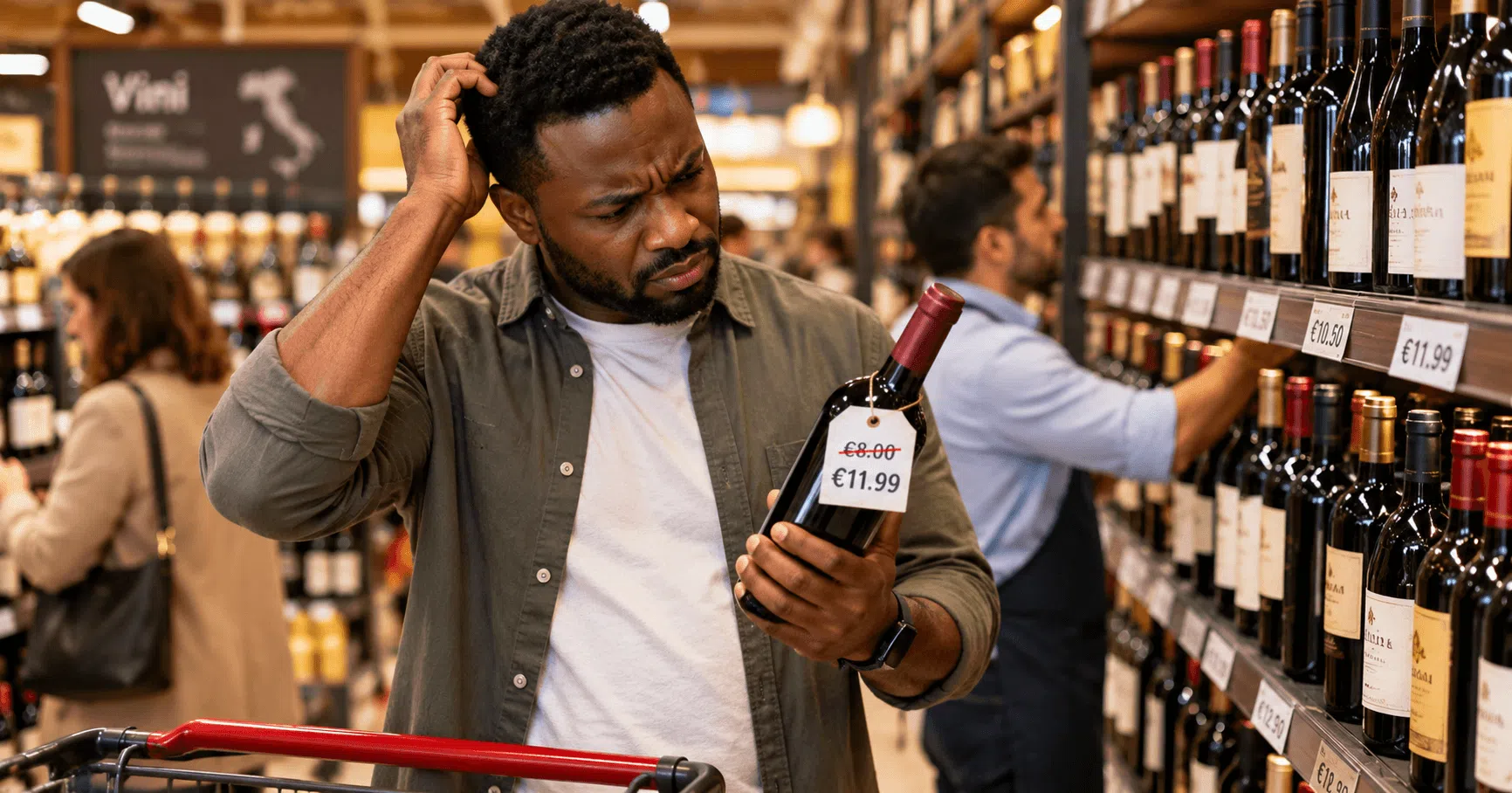
I have a small grievance with a bottle of wine I used to buy for about eight euros. It is now €11.99. Nothing dramatic appears to have happened to it in the meantime. Same label, same producer, same grapes. It hasn’t discovered Burgundy or hired a publicist.
Meanwhile, everything I read says people are drinking less wine. Consumption is falling. Exports are struggling. Some regions have spent the last few years deliberately producing less. So naturally I have a question: if the whole world is drinking less wine, why am I paying more for mine?
Quick Facts
- Global wine consumption fell to about 208 million hectolitres in 2025, down 2.7% from 2024 (OIV)
- Global wine production was 227 million hectolitres in 2025, kept low enough to broadly offset falling demand
- Italian wine exports fell 6.2% in value and 4% in volume in the first half of 2026 (Unione Italiana Vini)
- The average price Italian wineries received for their exports actually fell 2.3% over the same period, even as retail prices for consumers kept climbing
Yes, We Really Are Drinking Less Wine
This part isn’t imaginary. The International Organisation of Vine and Wine puts global wine consumption at around 208 million hectolitres in 2025, down 2.7% from the year before. This is not a one off dip. Consumption has been sliding for years as drinking habits shift. Younger consumers behave differently around alcohol, health concerns weigh more heavily, and household budgets get rethought from top to bottom. Italy isn’t exempt either. Italian wine exports fell 6.2% in value and 4% in volume in the first half of 2026 alone.
So if your immediate thought is less demand should mean cheaper wine, congratulations, that was mine too. Unfortunately, that logic skips over everything that happens to a bottle before it ever reaches us, including, apparently, mine.
That €10 Bottle Was Never €10 of Actual Wine
When I look at a bottle, I see wine. The winery sees something closer to a small financial family reunion. Grapes, vineyard labour, pruning, harvesting, fuel and electricity, equipment, fermentation, storage. The glass bottle itself, the cork or screwcap, the label, the capsule, the cardboard it travels in. Transport, warehousing, distribution, taxes, and the retailer’s own margin on top of all of it. Somewhere in that queue, ideally, the person who actually made the wine gets to keep something too.
This is what makes wine pricing so confusing to argue with. The liquid inside the bottle is only one line item among many. Even if grapes get cheaper because a region grew more than it needed, that doesn’t make the glass, the energy, the transport or the labour any cheaper. The cardboard box has not agreed to participate in anyone’s wine crisis, mine included.
Cheap Wine Has Nowhere to Hide These Costs
This gets especially interesting at the bottom of the shelf, which is exactly where my own complaint lives. Imagine the non wine costs attached to a bottle, packaging, transport, labour, rise by a euro. On a hundred euro bottle, that’s barely noticeable. On an eight euro bottle, that euro is the entire story. Lower priced wines feel cost increases far more sharply precisely because packaging, transport and labour make up a much bigger share of what you’re actually paying for. The grapes haven’t become more delicious. The bottle hasn’t learned a new trick. It simply costs more to get the whole thing onto a shelf. That’s presumably how my old €8 bottle ended up wearing an €11.99 sticker with absolutely no remorse. Cheap wine, it turns out, has the least room to absorb a bad year quietly.
But Doesn’t Europe Have Too Much Wine Sitting Around?
Sometimes, in specific places, and that distinction matters enormously. I’ve written before about the strange situation playing out across Europe right now. Italy was sitting on 42.6 million hectolitres of stock as of July. France, just across the border, was heading into its smallest harvest since 1957, with Champagne production down 49% year on year in the same season.
That’s not two countries disagreeing about how much wine the world needs. It’s one country with too much of certain styles and another with not nearly enough, at the same time. Nobody can simply swap inventory across a border, because wine doesn’t work like that.
Why the Global Market Still Counts as Balanced
This doesn’t mean the entire world is floating in one giant pool of surplus wine. The OIV’s own figures put global production at 227 million hectolitres in 2025, against that 208 million hectolitre consumption figure. OIV director general John Barker described the market as broadly balanced. Production has stayed low enough, for three years running now, to offset the drop in demand rather than pile up as unsold stock. Italy itself voluntarily held back yields this year specifically to manage its own stock levels, which tells you producers are already adjusting rather than quietly drowning.
So the real problem is more specific than a global glut. A particular region can end up with too much of a particular style. A famous appellation can stay expensive while bulk wine two shelves over gets hammered on price. Wine has a matching problem more than it has a surplus problem. Matching problems don’t fix themselves just because the evening news says consumption is down.
The Strange Part: Wineries Aren’t Necessarily Getting Richer Either
If I’m paying more for a bottle, my instinct is to assume somebody upstream is pocketing the difference. Not necessarily. Italian export data from the first half of 2026 shows the average export price actually fell by 2.3%. Sit with that for a second. Demand weakened, export volumes dropped, and export value dropped further still. The average price wineries received for what they did manage to sell also went down.
Some producers are being squeezed from both directions at once. Their own costs don’t politely disappear just because global consumption is falling, but the market also refuses to simply absorb higher prices. Costs stay high, buyers want to pay less, and the margin gets crushed in the middle. So yes, a bottle can cost more in your local shop. Meanwhile the winery behind it is telling anyone who’ll listen that the business has never been harder. Both things are true at once. Wine economics is rude like that, and somewhere, a producer is reading roughly the same headlines I am, feeling exactly as betrayed.
We’re Drinking Less, But Sometimes Better
There’s a second force sitting underneath all of this, and it has nothing to do with costs at all. Some of what I’m paying for now simply isn’t the wine, it’s everything wine has come to represent.
This is premiumisation, a slightly clinical word for a very human habit. Someone who once opened an inexpensive bottle three or four nights a week might now drink far less often but spend more when they actually do. A proper bottle for Saturday dinner. Real Champagne instead of the everyday sparkling wine. An occasional Barolo rather than a weekly basic red. My simpler translation: if you’re going to drink less, you might as well enjoy what you open.
Wineries have noticed this shift, which is part of why the overall market can shrink in volume while entire categories within it get pricier. Fewer bottles moving, more value attached to the ones that do.
And Sometimes, Yes, You’re Paying for the Name
Not every extra euro ever went into better grapes to begin with, something I’ve gone after directly in my rundown of the wine myths worth retiring. Reputation, scarcity, a famous appellation, vineyard land prices, critic scores and producer prestige all sit in the price with surprisingly little regard for what’s actually fermenting. If thousands of people want a limited run of bottles from one celebrated vineyard, that wine isn’t becoming cheap just because global consumption dipped for the year. A hillside in a prestigious corner of Barolo or Champagne doesn’t get cheaper because people elsewhere drank less wine on a Tuesday.
Going from a genuinely bad four euro bottle to a well made twelve euro one is a real jump in quality. Going from twenty euros to a hundred gets far murkier. Blind tastings routinely show people struggling to pick the ten euro bottle out from the fifty euro one. That tells you plenty about where the extra money is actually going. Wine doesn’t run on a tidy ten euro per extra unit of deliciousness scale. It would make shopping considerably easier if it did.
So Where Does That Leave the Smart Shopper?
This is honestly the fun part. When famous names can hold their prices just because people recognise them, real value tends to hide somewhere less fashionable right next door. Everyone wants Barolo, fine, Nebbiolo grown outside the Barolo zone is often remarkable for a fraction of the price. Brunello feels painful this year, Tuscany has not run out of Sangiovese grown under other names. Champagne is stretching the budget, Italy’s traditional method sparkling wines deserve far more attention than they get.
Italy in particular is brilliant for this game. It has an almost unreasonable number of grapes, regions and denominations to explore, instead of paying a premium for the one everybody already knows. I’ve put together a list of bottles that genuinely taste more expensive than they are for exactly this reason. The trick isn’t simply hunting for cheap wine. It’s learning where you’re paying for what’s actually in the glass, and where you’re paying for the name on the label. Those are rarely the same thing, and my €11.99 bottle, for what it’s worth, has no name worth paying for at all.
So Why Is My €8 Bottle Now €11.99?
Probably not for one single reason. Production costs could have risen, or packaging, transport or energy did. The retailer may have quietly adjusted its margin, or the producer repositioned the wine entirely. Perhaps the old price simply wasn’t sustainable to begin with. And sometimes, honestly, somebody just decided people would pay more, which is also a legitimate business strategy, if an irritating one from where I’m standing with my shopping basket.
What you can’t do is look at falling global consumption and assume every single bottle should therefore get cheaper. There is no one wine market. There are thousands of producers, regions, grapes, price tiers and supply chains, all moving in different directions at once. That’s how every one of these can be true at the same time. People are drinking less wine. Some producers are struggling to sell what they make. Some wine prices are genuinely under pressure. And some bottles, mine included, still cost more than they used to. Wine hasn’t broken economics. It’s just considerably messier than a shelf price ever lets on.
Frequently Asked Questions
Are people really drinking less wine? Yes. The OIV estimates global wine consumption at around 208 million hectolitres in 2025, down 2.7% from 2024, continuing a longer term decline across many established wine markets.
If demand is falling, shouldn’t wine get cheaper? Not automatically. Retail price includes farming, labour, packaging, energy, transport, distribution, taxes and retailer margin on top of the wine itself, and these costs don’t fall just because fewer bottles are being sold.
Does Europe currently have too much wine? Some regions and categories have real oversupply problems, Italy was sitting on 42.6 million hectolitres of stock in July, for instance, but that’s different from a global surplus. The OIV describes the 2025 global market as broadly balanced, since low production in recent years has offset falling consumption overall.
Are Italian wine export prices rising or falling? Falling. Italian export data from the first half of 2026 shows the average export price down 2.3%, alongside a 6.2% drop in export value and a 4% drop in volume.
Does a higher price always mean better wine? No. Price can reflect genuine quality, but also scarcity, a famous appellation, vineyard land costs, required ageing, critic scores and producer reputation, which don’t always track with what’s actually in the glass.
How can I find better value Italian wine? Look just outside the most famous names. Lesser known regions, neighbouring denominations and native grape varieties often deliver excellent quality without the price premium that comes from name recognition alone.
I started this with a fairly petty complaint. My eight euro wine had quietly become an €11.99 wine, and I wanted somebody to explain themselves. Instead I found something more interesting than a villain. Falling consumption doesn’t automatically mean falling retail prices, because we were never paying for fermented grape juice alone, we’re paying for farming, labour, glass, corks, energy, transport, distribution, retail margin, and depending on the bottle, reputation and scarcity on top of all of it. So will I understand my supermarket receipt better next time. Yes. Will I still stand in the aisle staring at that same bottle like it personally betrayed me. Also yes.
— Kelly 🍷
#ItalianWine #WinePrices #WineEconomics #WineIndustry
Continue Reading
- Europe Has Too Much Wine. So Why Is France Running Out?
- Best Cheap Italian Wines That Taste Expensive (Top Picks Under €20)
- 7 Common Wine Myths That Deserve to Be Debunked
Enjoy wine without the snobbery?
Make The Finest Italian Wine one of your Preferred Sources on Google.
Add The Finest Italian Wine to Preferred SourcesDiscover more from The Finest Italian Wine
Subscribe to get the latest posts sent to your email.