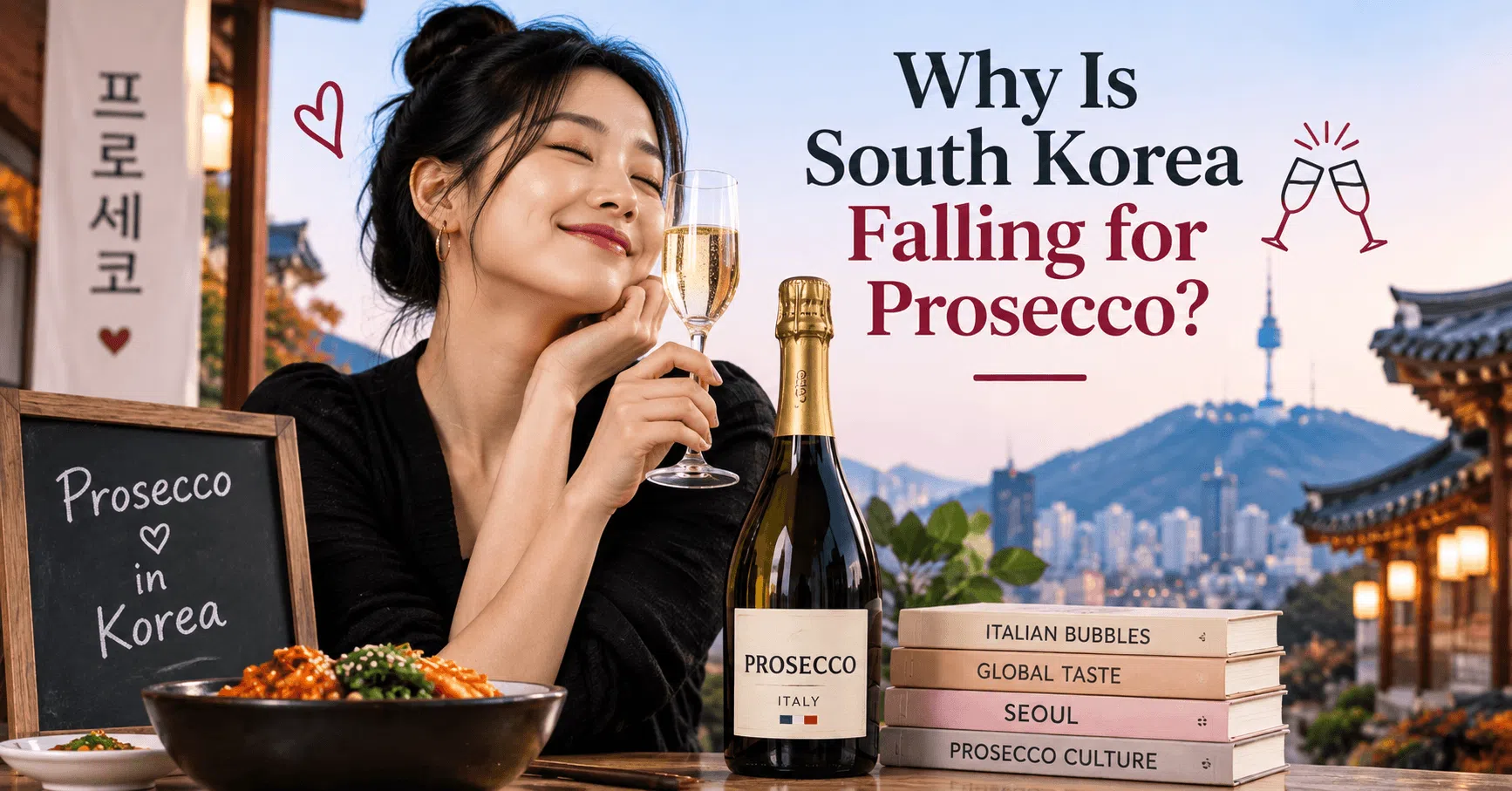
Why Is South Korea Falling for Prosecco?
Prosecco has traveled again. This time it hasn’t gone to another bottomless brunch in London or a wedding where somebody’s aunt starts dancing before the food arrives.
It’s in Seoul, sitting beside Korean food.
Prosecco DOC sales in South Korea rose 9.8% between January and April 2026. The campaign behind that number, called Uncorking Prosecco DOC 2026, has brought six Italian wineries into more than 35 restaurants and bars across the city: Biasiotto, La Gioiosa, La Marca, Serena Wines 1881, Tenuta Santomè, and Torresella. But the percentage isn’t really the interesting part. It’s what they’re doing with the wine. Prosecco is being paired with Korean food, meat, seafood, and dessert. It showed up at Frieze Seoul, the international art fair, through an event organized with the Italian Embassy. There have been masterclasses for sommeliers and buyers. This isn’t Italy shipping bottles to Korea and hoping for the best.
Which made me wonder: why does Prosecco seem able to walk into a completely different drinking culture? And make itself comfortable almost immediately?
South Korea’s growing interest gives a real clue. Prosecco is approachable, easy to understand, and works with a surprising range of food. It feels celebratory without being formal, and carries an Italian lifestyle image that travels well. In other words, it doesn’t arrive with a long list of demands.
Prosecco Doesn’t Make You Study Before You Drink It
I love Italian wine, but sometimes Italian wine behaves like an exam you didn’t know you’d signed up for.
DOC. DOCG. Classico. Riserva. Superiore. Appassimento. Ripasso. Then somebody mentions the grape isn’t even on the label, because apparently you were supposed to know that already. If you’re new to Italian wine, I understand the temptation to quietly reach for something simpler.
Prosecco largely escaped that complication. See the word on a bottle and you already have a reasonable idea of what’s coming. Bubbles, freshness, fruit, something cheerful. There’s genuinely more nuance underneath that. Different sweetness levels, different quality tiers, real distinctions between Prosecco DOC, Asolo Prosecco DOCG, and Conegliano Valdobbiadene Prosecco Superiore DOCG. But nobody needs to understand any of that before enjoying a first glass.
That simplicity becomes especially valuable the moment a wine travels somewhere Italian wine isn’t already part of everyday drinking life. Prosecco feels unmistakably Italian without demanding a short course before you’re allowed to order it. That’s a genuine talent.
Then There’s Korean Food, Which Isn’t Shy
This is where the South Korea story got genuinely interesting to me, because Korean food doesn’t hold back.
Spice, fermentation, sweetness, salt, acidity, garlic, chili, grilled meat, seafood, kimchi. All of it can show up at the same table at once. Put the wrong big, tannic red next to that spread and something goes wrong fast. Both the food and the wine end up fighting for custody of your mouth.
Prosecco has an easier job. Its acidity refreshes the palate. Its bubbles work beautifully against rich or fried food, and its fruit-forward character tends to be friendlier with spice than a heavily tannic wine would be. Because it generally arrives without much weight or alcohol, it plays a different role. It can accompany a meal rather than sit on top of it.
Take bossam, the Korean dish of pork typically served with kimchi and various side dishes. It’s a real example, too. One of this campaign’s own restaurant partners, Won Grandma Bossam, a specialist operating since 1975 with over 200 locations across Korea, is part of it. You’ve got richness from the pork, salt, fermentation, freshness, and spice all at once. A crisp sparkling wine next to that doesn’t read as an Italian import crashing a Korean dinner. It reads as a reasonable choice.
The same logic extends to fried dishes and seafood, though the specific style matters here. Extra Dry Prosecco, despite the confusing name, carries more residual sugar than Brut. It can be more forgiving with certain spicy dishes. A drier Brut works better where freshness matters more than sweetness. None of this means any bottle of Prosecco automatically works next to anything covered in gochujang. Please don’t blame me for what happens next. It does mean Prosecco gives itself several genuine chances to succeed, though, which matters enormously when a wine is entering an unfamiliar food culture.
Korea Isn’t Just Falling for Acidity and Bubbles
If food pairing explained the whole story, plenty of other sparkling wines could pull off the same trick. What Prosecco sells particularly well is a feeling.
Look at how the Seoul campaign is really positioned. It isn’t being introduced only through tastings and restaurant wine lists. The Consorzio connected it to food, fashion, art, and contemporary Italian lifestyle, including that Frieze Seoul appearance. That’s smart, because nobody falls for a wine region because somebody handed them an export spreadsheet.
Prosecco has always sold something beyond what’s genuinely in the glass. It sells aperitivo, friends arriving, Friday evening, weddings. The exact moment somebody says “should we open something?” and nobody needs much convincing. You don’t have to have grown up in Veneto to understand any of that. Meeting friends after work isn’t Italian. Celebrating isn’t Italian. Wanting something cold and bubbly before dinner isn’t Italian either. The occasion translates even when the culture around it changes completely, and that might be Prosecco’s single greatest international advantage.
It Feels Special Without Requiring a Special Occasion
Champagne owns prestige in a way very few wines ever will. That prestige means plenty of people still save it for birthdays, anniversaries, and moments important enough to justify the price tag.
Prosecco occupies different territory entirely. It can feel festive without making you interrogate what exactly you’re celebrating. That’s a genuinely strong position for a wine to hold, especially in a developing market. Nobody has to decide they’re suddenly “a wine person.” They can just decide they like Prosecco. It’s a much easier first date.
Price helps too. Prosecco generally offers access to Italian sparkling wine at a friendlier price than Champagne. The category itself still ranges from inexpensive supermarket bottles all the way to serious wines from specific hillsides and top-tier DOCG zones. I’ve gone into that fuller picture, and how Prosecco compares to Champagne beyond price, in a piece on the two wines directly. Internationally, though, the broad message stays wonderfully simple: Italian bubbles that feel fun, stylish, and accessible. That’s a far easier product to introduce across cultures. A wine whose entire identity depends on someone already understanding one specific village’s traditions has a much harder time of it.
None of This Is Happening by Accident
It’s tempting to tell this story as though South Koreans simply woke up one morning and discovered Prosecco. They didn’t.
The campaign involves more than 35 restaurants and six named wineries. There are professional masterclasses for sommeliers and buyers, real Korean chefs brought directly into the conversation, and deliberate placement of Prosecco beside Korean cuisine rather than insisting it only belongs with Italian food. That’s the genuinely clever part. Getting a wine to succeed abroad means convincing more than the person drinking it. The importer has to believe in it. The restaurant has to list it, the sommelier has to recommend it, the chef has to see where it fits, and the customer has to order a second glass.
A 9.8% increase over four months suggests real momentum. It’s worth staying grounded, though. Four months of growth doesn’t mean South Korea has suddenly become the next giant Prosecco market. It means something is working well enough to deserve continued attention. Part of what’s working, I suspect, is that Prosecco isn’t being presented as a foreign wine Koreans need to learn how to drink “properly.” Instead, it’s being invited straight into how people already eat, socialize, and celebrate, which is a considerably smarter introduction than the alternative.
Prosecco May Have Accidentally Prepared for How We Drink Now
There’s another reason this story caught my attention. I’ve written before about why Italians themselves are drinking less wine overall, and “people are drinking less wine” sometimes gets treated as though everyone simply woke up and stopped liking it.
Drinking habits are more layered than that. Someone can drink less wine overall while drinking more sparkling wine specifically. Another person can stop opening a bottle every evening but still order bubbles when meeting friends. A third, interested in moderation, can prefer a lighter drinking occasion without giving up alcohol entirely. Prosecco happens to fit neatly into exactly that world. It doesn’t need to accompany an entire dinner. It can open the evening, sit beside food, become a cocktail, celebrate something major or absolutely nothing at all. That flexibility is doing real work here. It might be the real reason Prosecco has traveled as successfully as it has. It was never tied to one rigid way of being consumed.
So Why Is South Korea Falling for Prosecco?
Food compatibility helps. So does the accessible price. The bubbles are easy to understand, and the wine feels special without turning formal. The Italian lifestyle surrounding it is part of the appeal too.
But underneath all of that, I think there’s something simpler. Some wines travel with a long list of instructions. Prosecco travels with an invitation. South Korea doesn’t have to recreate a Venetian bacaro before the bottle makes sense. A restaurant in Seoul can put Prosecco next to bossam, seafood, or something fried. Then it just lets the wine find its own place at the table. That’s probably the cleverest thing about its international success. It doesn’t ask the rest of the world to become Italian before opening the bottle. It shows up, meets whatever’s already on the table, and joins in.
Honestly, that’s a very Italian way to conquer the world.
Quick Answers
Is Prosecco popular in South Korea? Interest is growing quickly. Prosecco DOC sales rose 9.8% between January and April 2026, alongside an expanded restaurant, trade, and cultural presence across Seoul through the Uncorking Prosecco DOC 2026 campaign.
Does Prosecco go with Korean food? Yes. Its acidity and carbonation work especially well with rich, fried, salty, and moderately spicy dishes. The right choice depends on the specific dish and the sweetness level of the Prosecco itself.
What Prosecco style works best with spicy food? A fruitier style like Extra Dry can sometimes handle moderate spice better than Brut, since it carries more residual sugar. Very hot dishes still need more careful pairing regardless of style.
Why is Prosecco so popular internationally? Its approachable flavor, food versatility, accessible pricing, and strong association with celebration and Italian lifestyle make it relatively easy to understand across very different drinking cultures.
Salute.
Continue Exploring
- The Complete Guide to Prosecco — Italy’s Most Joyful Wine
- Stop Calling Prosecco “Italian Champagne” — Here’s What It Actually Is
- Italy Has Fewer Wine Drinkers. They Got More Interesting.
Sources
Sales growth and campaign details are drawn from the Prosecco DOC Consortium’s official announcement, reported by Wine Industry Advisor and corroborated by PRNewswire’s original release, September 9, 2026.
Enjoy wine without the snobbery?
Make The Finest Italian Wine one of your Preferred Sources on Google.
Add The Finest Italian Wine to Preferred SourcesDiscover more from The Finest Italian Wine
Subscribe to get the latest posts sent to your email.