Celebrities Who Own Wineries: Neymar Has a Wine Now, and It Pre-Sold 300,000 Bottles
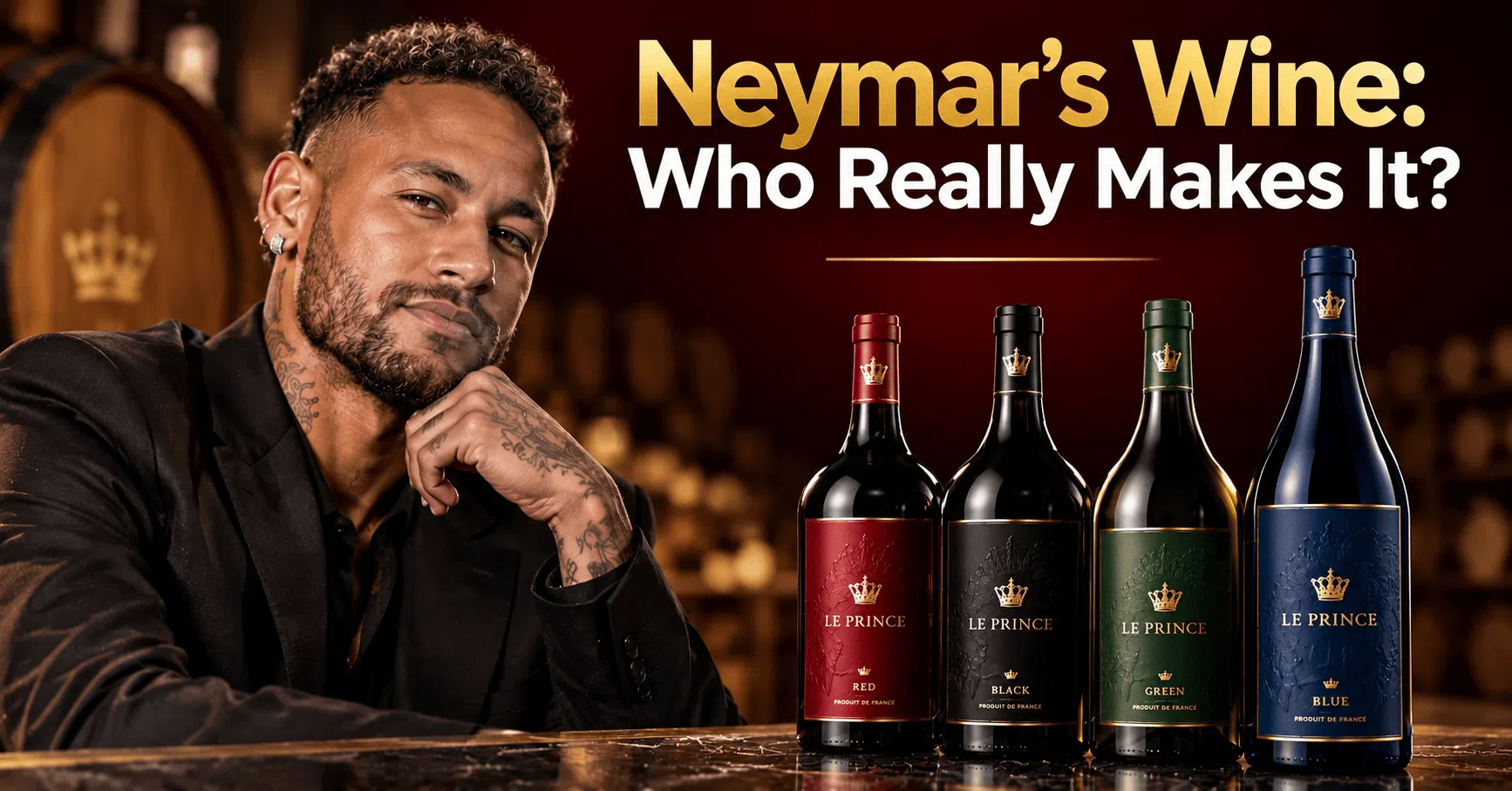
Guess who else has joined the footballers’ winery club? Neymar. Yes, that Neymar, the man who spends his days bending footballs into impossible corners and has now decided to try the same trick with a wine label. Meet the Neymar wine Le Prince, which reported advance sales of 300,000 bottles before a single one reached a shelf. Not 3,000. Three hundred thousand. Most small wineries would happily trade a harvest for that kind of head start.
But the most interesting thing about Le Prince isn’t the footballer on the label, or even the big number. It’s that the wine isn’t Brazilian, nobody reports Neymar choosing it, and the sales targets come in more sizes than the bottles do. So pour yourself something nice and let’s open this one together.
Quick Facts
- Le Prince launched in Brazil at the end of June 2026, run by the brand holding company JLX in partnership with Neymar’s family
- There are seven wines across four tiers, Red, Black, Green and Blue, sourced from Chile, Spain and France, and sold only in Brazil
- The Master of Wine Dirceu Vianna Junior, described as Brazil’s first, chose the grapes, blends and producers
- The name Le Prince refers to Neymar’s nickname “Príncipe da Vila” (Prince of the Vila), linked to his time at Santos
- The brand reports advance sales of 300,000 bottles, and its sales targets come in several versions
- A six-litre Blue-tier bottle sold at a charity auction on 3 August for around R$600,000, and the top bottles are priced up to R$50,000
Neymar Wine Le Prince: A Brand Built Like a Whisky House
Most wines are named after a grape, a vineyard or a place. Le Prince names its wines after colours, and the price climbs with them. Red starts at R$59.90, Black R$149 to R$199.90, Green R$250 to R$350 and Blue, the numbered collector tier, up to R$50,000. That’s not a wine habit. It’s a spirits habit, borrowed wholesale from whisky houses that sell you “12 Years” and “18 Years” long before you’ve tasted anything.
It works because nobody has to know Rioja from Châteauneuf-du-Pape to understand that Blue costs more than Red. The tiers do the selling before anyone reads a tasting note. According to CNN Brasil, the tiers also nod to Neymar’s career. Black is tied to his time at Barcelona, Green to PSG and the Blue bottles to goals. The football story is doing the work that a vineyard story usually does.
Where the Name Comes From
If you’re wondering why a Brazilian wine has a French name, the answer is a football nickname. Brazilian reports say Le Prince refers to Neymar’s nickname “Príncipe da Vila”, the Prince of the Vila. They link it to the start of his career at Santos FC. Paris Match’s Belgian edition describes it as the nickname he had during his youth years at Santos. None of the reports I found quote Neymar or the brand explaining the choice, so it’s the press’s reading, although it’s a very sensible one.
It’s a neat piece of branding. A French name signals the wine world, the nickname is pure Neymar, and nobody has to be told which is which.
The Wines Aren’t Even Brazilian
Here’s the detail that surprised me. Le Prince is sold in Brazil, but none of it is made there. The wines come from producers in three countries:
| Tier | Wines and producers |
|---|---|
| Red | Two Chilean wines made by Terraustral: a Sauvignon Blanc and a red blend of Cabernet Sauvignon, Malbec and Merlot |
| Black | An Albariño from Paco & Lola in Rías Baixas and a Rioja blend made with Bodegas Faustino |
| Green | A Châteauneuf-du-Pape (Grenache and Syrah) and an Abadía Retuerta wine, mainly Tempranillo and inspired by Vega Sicilia |
| Blue | Numbered collector bottles made with SGC, a boutique Saint-Émilion Grand Cru producer in Bordeaux |
So the “Brazilian footballer’s wine” is really a tour of Chile, Spain and France with a Brazilian name on the front. I find that rather charming, and also a little cheeky. I’ve written about another footballer’s label in Andrea Pirlo’s winery. The pattern across football is familiar: the famous name is rarely the one choosing the vineyard.
Is He in the Room, or Just on the Label?
This is the question I ask about every celebrity wine, because the answer separates a real project from a licensing deal with a photo shoot.
Here, the person making the wine decisions is Dirceu Vianna Junior, who lives in London and is described as Brazil’s first Master of Wine. Hiring a Master of Wine is the smartest thing Le Prince did, because it buys real credibility. CNN Brasil quotes him saying nobody ever imposed anything on him, and that he tried to combine his own philosophy with Neymar’s. The reports don’t say Neymar took part in blending or choosing producers. His family is a partner through JLX, and his name and career give the brand its story. That makes Neymar the face and the backer. I’d call it closer to chief marketing officer than winemaker, and the brand doesn’t pretend otherwise.
Compare that with Kyle MacLachlan or Kylie Minogue, and you can see how different the celebrity-wine spectrum is.
The Auction Bottle That Was Really a Press Release
On 3 August, a six-litre Impériale bottle sold at a charity auction for the Instituto Projeto Neymar Jr. Crusoé’s headline puts the price at R$600,000, though its own text says R$630,000, so call it around R$600,000. Whatever the exact figure, it did more marketing work in one night than most wine brands manage in a year of advertising. “Neymar”, “wine” and a six-figure price landed in the same headline everywhere, which was the point. The bottle was almost beside the question.
The Targets Come in Several Sizes
Here’s my favourite “oh really”, and it took a few reports to untangle. The brand’s sales goals are quoted in different sizes. Some reports say 1 million bottles and about R$25 million in the first year. Others say more than 4 million units and up to R$100 million by the end of 2026. One headline says 10 million units by the end of 2026, while another report says up to 10 million by the end of 2027. A separate BNews report from 7 October talks of 700,000 to 1 million bottles and about R$25 million in the 12 months up to June 2027. The reports don’t explain the gaps, and some of them mix up bottles and “rótulos” (labels).
Now look at the ratio. Both the R$25 million and the R$100 million figures work out at roughly R$25 of revenue per bottle, while the cheapest Le Prince sits at R$59.90 on the shelf. That isn’t necessarily a mistake, since a brand’s revenue is not the shelf price. Tax and the retailer’s margin come out first, and I’d guess that explains the gap, although none of the reports spell it out. What I can say is that these are projections, not results. And 300,000 is advance sales of bottles, not 300,000 people, with no breakdown between consumers and retailers.
Does It Pass the Celebrity Wine Test?
- Is the celebrity still in the room? Not as the winemaker. Forbes Brasil reports he isn’t directly involved in choosing the labels, though his favourite wine, Vega Sicilia, shaped the style. A Master of Wine makes the decisions.
- Is it from where they’re from? No. Neymar is Brazilian, and the wine comes from Chile, Spain and France.
- Has it lasted? Too early to say, since Le Prince is a few months old.
- Does the wine hold up on its own? Unknown. I haven’t found independent critic scores, and the Master of Wine told Forbes Brasil he doesn’t chase medals but “exceptional value for money”.
That’s two clear no’s, one too early and one unknown. It’s a tougher score than most names in this series, and I’d say Le Prince is a marketing achievement first and a wine project second. That isn’t automatically bad business. If the advance sales hold up, the market clearly doesn’t mind.
Frequently Asked Questions
Who makes Neymar’s wine, Le Prince? Several producers in three countries. Terraustral is in Chile, and Paco & Lola, Bodegas Faustino and Abadía Retuerta are in Spain, a Châteauneuf-du-Pape producer in France and SGC in Saint-Émilion for the top tier. Dirceu Vianna Junior, a Master of Wine, chose the grapes and blends.
Is Le Prince a Brazilian wine? No. It’s sold in Brazil, but the wine is made in Chile, Spain and France.
How much does Le Prince cost? Red starts at R$59.90, Black runs R$149 to R$199.90, Green R$250 to R$350 and the numbered Blue tier goes up to R$50,000.
Is Neymar’s wine any good? I can’t say yet. I haven’t found independent critic scores.
Why is it called Le Prince? Brazilian reports say the name refers to Neymar’s nickname “Príncipe da Vila”, linked to his time at Santos FC. No direct explanation from Neymar or the brand has been quoted.
How many bottles has Le Prince sold? The brand reports advance sales of 300,000 bottles. Its targets come in several versions. They run from about 1 million bottles in the first year to more than 4 million, and in some reports up to 10 million, by the end of 2026 or 2027.
One Last Thing
Everyone in this series gets the same question: did the celebrity make the wine, or just sign it? With Le Prince the honest answer is that the best decision was handing the wine to someone who knows how to make it. The test isn’t whether a footballer can blend a Rioja. It’s whether the bottle is any good once the marketing is gone, and that’s the part nobody can tell you yet.
Would you buy a celebrity’s wine because of the name, or only if a critic you trust had approved it? I’d like to know.
— Kelly 🍷
#CelebrityWinery #Neymar #LePrince #FootballerWine #WineAndPeople
Continue Reading
- Celebrities Who Own Wineries: Andrea Pirlo
- Celebrities Who Own Wineries: Kyle MacLachlan, Pursued by Bear and His Dad
- Celebrities who Own Wineries: Kylie Minogue
Sources
- CNN Brasil: Vinho do Neymar, conheça a Le Prince, com garrafas de até R$ 50 mil
- Crusoé: Marca de vinho de Neymar estreia com garrafa de seis litros comprada por R$ 600 mil
- Sa Mais: Nova linha de vinhos projeta venda de mais de 4 milhões de garrafas até o final do ano
- All4Wine: Le Prince, Família Neymar se une a Master of Wine e entra no mercado de vinhos
- Terra Brasil Notícias: Família de Neymar lança marca de vinhos
- Paris Match Belgique: Un nouveau chapitre pour Neymar, Le Prince est officiellement né
- BNews: Marca de vinhos de Neymar pode faturar R$ 25 milhões no primeiro ano
- Forbes Brasil: Vinho preferido de Neymar inspirou rótulo da linha assinada pelo craque
Enjoy wine without the snobbery?
Make The Finest Italian Wine one of your Preferred Sources on Google.
Add The Finest Italian Wine to Preferred SourcesDiscover more from The Finest Italian Wine
Subscribe to get the latest posts sent to your email.