Why Do We Say Cheers Before Drinking? The Real Story

There are things we do with wine that nobody seems to question.
Someone raises a glass, everybody else immediately raises theirs.
Someone says, “Cheers!” We clink, We drink, Life continues. Nobody asks why.
Which is strange when you think about it.
Why do I need to knock my glass against yours before I can drink my wine? Why am I saying “cheers”? And why, if there are six people at the table, do I suddenly feel personally responsible for making sure my glass touches everybody else’s?
I went looking for the answer.
I found poison, Romans and actual toast floating in wine, much better than I expected.
Why Do We Say Cheers Before Drinking?
Today, saying “cheers” before drinking is basically a wish.
Good health. Good luck. Happiness. Congratulations. Here’s to us.
One tiny word has been given a lot of jobs.
But people were raising drinks to one another long before anyone shouted “cheers.”
Ancient Greeks and Romans had drinking rituals. Wine was raised in honour of gods, the dead, victories and other people.
The Romans, particularly, had opinions about wine. These are the same people who once had an emperor try to ban new vineyards in Italy.
So no, Romans weren’t standing around saying “cheers.”
But the idea of pausing before drinking and dedicating the drink to someone or something is very old.
The word came much later.
Where Did the Word “Cheers” Come From?
Surprisingly, “cheers” wasn’t originally about drinking.
The word developed from older meanings connected with the face, mood and eventually happiness and good spirits. You can still hear that meaning today. We cheer somebody on, crowds cheer.
We tell miserable people to cheer up, which I’m sure they find enormously helpful.
Eventually, “good cheer” became something you could wish another person.
And somewhere along the way, we shortened the whole thing to: Cheers.
Much easier when you’re holding a full glass.
Was Clinking Glasses Really About Poison?
Now we get to the story I desperately wanted to be true.
Apparently, people once banged their drinking cups together so hard that some of the liquid splashed from one cup into another. Why? Poison.
If you had poisoned my wine, congratulations. Some of my wine was now in your cup too, drink up.
I loved this explanation immediately.
Wine. Betrayal. Suspicious dinner guests. Potential murder, unfortunately, there isn’t solid historical evidence that this is why we started clinking glasses. The story has simply been repeated so many times that it sounds true. Shame.
I was ready to imagine every medieval dinner as a very badly organised episode of Game of Thrones.
The clink seems to belong more broadly to the shared ritual of drinking together. Everyone raises a glass, everyone joins the moment, everyone hears that little sound. Less murder, probably better for dinner parties.
Why Is It Called a “Toast”?
This one is even stranger, because there was actual toast involved. Bread.
People really did put toasted or spiced bread into wine and other drinks. Over time, the word toast became connected with drinking in someone’s honour.
Which means every time someone stands at a wedding and says:
“I’d like to propose a toast…” there is a little piece of bread hiding somewhere in the history of that sentence.
Apparently, the bread could help flavour the drink, which also tells you something about the drink.
If your wine needs a slice of toast dropped into it before anybody can face it, I think the wine and I need to have a conversation. Thankfully, wine improved. The word stayed.
What Does “Cheers” Mean Today?
Pretty much whatever good thing the moment requires. To your health, To your marriage, To the new job, To friendship, To surviving this week, To finally getting the children to bed.
The exact words aren’t really the point, for a few seconds, everybody stops what they’re doing and agrees that something deserves celebrating, then we drink. I rather like that.
What Do Italians Say Instead of Cheers?
In Italy, the easiest one to remember is: Salute! Health.
Straight to the point, raise the glass, wish everybody good health, drink.
You’ll also hear: Cin cin!
I used to think this was simply Italians imitating glasses touching, Cin cin, Clink clink.
It makes perfect sense, which is exactly why it isn’t true.
The expression travelled into European languages from an expression of courtesy with Chinese origins and eventually became associated with drinking and toasting in Italian.
So cin cin sounds suspiciously like two wine glasses touching, but that’s not actually where it started.
Nothing in this story has behaved itself.
If you’re ever at an Italian table and forget which one to say, there is also a highly sophisticated technique: Wait half a second, listen to everybody else, copy them, drink. Works beautifully.
Wine Is Full of Things We Do Without Asking Why
We inspect corks as though the cork is about to confess something.
And sparkling wine has created its own collection of rules and misunderstandings.
If you’ve ever called Prosecco “Italian Champagne,” for example, Prosecco vs Champagne vs Spumante may cause you a small inconvenience.
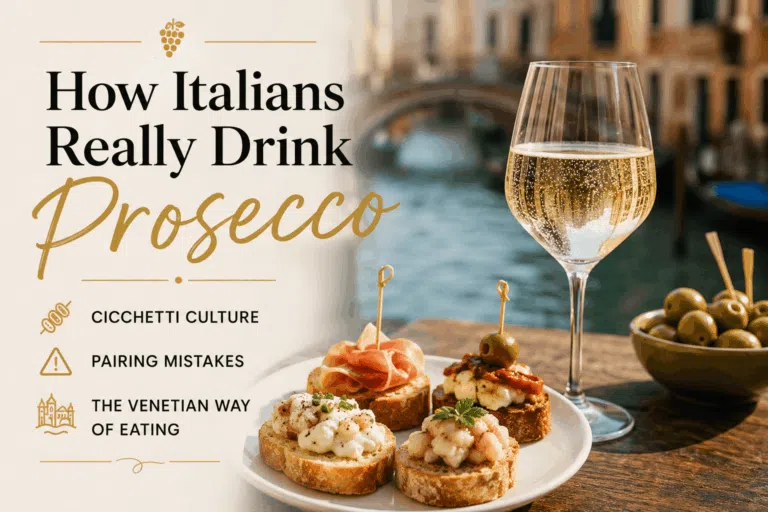
And in Italy, Prosecco isn’t always the grand celebration drink outsiders imagine. How Italians actually drink Prosecco has much more to do with aperitivo, cicchetti and a quick glass that somehow develops into another one.
Some wine traditions have science behind them, some have history, some are probably nonsense, we keep doing them anyway.
So Why Are We Still Saying Cheers?
This might be the question I like most.
We don’t need to do it.
The wine won’t taste different if we skip the toast, nobody is checking, and yet think about when the glasses go up.
Birthdays, Weddings, Christmas, New jobs, Old friends, Someone coming home, Someone leaving, A Friday that has behaved like it was personally sent to test you. For one second, everyone stops, Glasses go up, People look at each other.
Cheers.
Then life carries on, maybe that’s why the ritual survived, not because we’re checking for poison, not because the Romans told us to, and definitely not because somebody once put bread in wine.
We kept doing it because there is something rather nice about acknowledging the people around your table before taking that first sip.
One word. One clink.That’s enough.
Salute.
Enjoy wine without the snobbery?
Make The Finest Italian Wine one of your Preferred Sources on Google.
Add The Finest Italian Wine to Preferred SourcesDiscover more from The Finest Italian Wine
Subscribe to get the latest posts sent to your email.